The question we get asked every November
A two-day seminar is booked, the outdoor activities are chosen, and the person organising it writes to us a few weeks ahead: what if it rains? Would you have something that works indoors?
That is the real entry point to a casino night, and it is better said than dressed up. Nobody builds a seminar around a blackjack table. Plenty of people, however, are looking for an evening that holds whatever the weather does, demands no physical fitness and leaves nobody out. Against that specific brief, the casino is hard to beat.
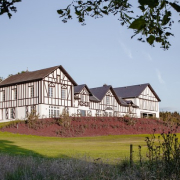
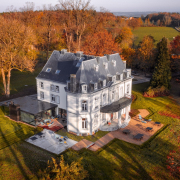
We run these evenings at the Domaine de Bronromme and the Château de la Louveterie, in the Belgian Ardennes. Deloitte, BMW and the CHU are among the companies that have passed through our two estates.
/--/uploads/2026/07/soiree-casino-entreprise-rire-table-jeu.jpg)
The activity that never says “there are too many of us”
This is the least known point, and probably the most decisive one when you are organising for a large group. Most team building activities carry a headcount limit written into their very nature:
- fat bike outings run with eight to fifteen participants;
- a cooking workshop tops out around twenty-four, because there is a finite number of worktops;
- a soap-making workshop stops at twelve;
- an archery session needs at least ten to make any sense.
A casino night has neither a minimum nor a maximum. It does not stretch, it adds up: you add a table, and its croupier comes with it. Twelve people or a hundred and eighty, the mechanics are identical, only the number of tables changes. That is what makes it, in our catalogue, the most flexible activity for a large headcount, or for a headcount still uncertain at the time of booking.
What does a casino night cost?
750 € excluding VAT per gaming table, and you choose how many tables. The price covers the table, its equipment and one dedicated professional croupier, who stays at that post all evening.
The evening itself runs two to four hours depending on the format, and we recommend two to three. Under two hours, beginners have barely finished learning the rules by the time the tables close. Past three, attention drops and people drift away before the standings are announced.
Pricing by the table is not an accounting quirk. It lets you set the density of your evening: three tables for thirty people gives a comfortable rhythm, three tables for eighty gives a queue. We will tell you honestly how many you need for your headcount, and it is not always the figure that suits us.
The venue is hired separately on top of that. A single room for the day starts at 850 € excluding VAT for the Bergerie, and rises to 2,200 € for the large 350 m² room. The four spaces are detailed in our article on equipped meeting rooms. For a stay, one night for the whole estate is 2,600 € excluding VAT, two nights 3,400 €.
Set against a residential seminar budget, a casino night therefore weighs a few hundred to a few thousand euros. It is never the main line of the quote.
/--/uploads/2026/07/soiree-casino-entreprise-distribution-cartes-jetons.jpg)
Three games, three decisions with nothing in common
Many organisers treat the three tables as variations on the same entertainment. That is the opening mistake, because each one calls on something different.
Blackjack is the only casino game where a right answer exists. For every hand, against every dealer upcard, basic strategy says whether to hit, stand, double or split. A player who follows it brings the house edge down to around 0.5 %, where instinct alone leaves it several times higher. This is the table for those who accept that a method beats a hunch.
Poker is the only game where the opponent is human. You are not playing the house, you are playing your colleagues, and information is worth more than cards. Position at the table often matters more than a good hand: acting last means deciding while knowing what everyone else did. Your teams find out there who knows how to wait.
Roulette, for its part, is not played the way people think. It deserves a paragraph of its own.
/--/uploads/2026/07/soiree-casino-entreprise-blackjack-as-et-roi.jpg)
Does roulette have a strategy?
You often read that it calls for none. That is wrong, and the misconception misses what roulette brings to a company evening.
No player can influence the ball, granted. But on a European wheel, thirty-seven pockets and a single zero, everyone chooses their exposure to risk, and that choice is anything but neutral:
- betting red or black means winning a little, often: eighteen chances in thirty-seven, about 48.6 %, paying even money;
- betting a single number means winning a lot, rarely: one chance in thirty-seven, paying thirty-five to one;
- dozens and columns sit in between, roughly one chance in three, paying two to one.
The expected value is identical in all three cases. What changes is the variance, which is to say the shape the evening will take for that player. Choosing between those three stances means announcing your relationship with risk in public, with a number behind it. That is why we rarely open an evening with roulette, and why we never close one without it.
/--/uploads/2026/07/soiree-casino-entreprise-lancer-de-la-roulette.jpg)
What does it actually change?
Hierarchy is suspended for the length of the game. A director losing a bet to the intern who arrived three weeks earlier, in a room where fifteen people are watching, is a scene office life never produces. It changes how those two speak to each other the next day.
Groups genuinely reshuffle. Rotating between tables breaks up the clusters that always reform in the same seats. Twenty minutes side by side at a blackjack table is longer than three coffee breaks.
Managers observe without assessing. Watching a colleague decide under uncertainty, in public and with no consequence for the company, is something no appraisal form allows. Provided you watch, and say nothing about it that evening.
These effects belong to games where you decide fast, in front of witnesses, with nothing real at stake. A murder party produces them too, in a narrative register.
How does the evening run?
One thing first: a casino night is played at night. Writing that looks pointless, except the request sometimes comes in for an afternoon slot, and the format does not survive it. The casino needs low light, dinner behind it and a full day behind that.
Its exact place is a hinge: it closes the working day and it opens the party. In practice it almost never sells on its own, and comes after an active day outdoors, often after an Ardennais Challenge or a walk in the forest. Hard day outside, gentle evening inside: that sequence comes back so regularly in our quotes that it can be treated as the standard format.
One point before the running order, because it lands in the first questions almost every time: no real money is ever played. The notes and chips are fake, nobody stakes a cent, nobody leaves with winnings. This is not gambling, it is entertainment that borrows its codes.
That is also what makes it interesting. A participant risking nothing dares things they would never dare with their own wallet, and that is precisely where they show themselves.
The backbone of the evening, meanwhile, does not move.
- The stake. Everyone receives the same starting bankroll, in play money.
- The learning. Each croupier explains the rules at their table. The first hands are there to be understood, and nobody is keeping score.
- The rotation. Players change games. This is when departments mix, and it does not happen on its own: the croupier makes it happen.
- The switch. Winnings are counted, the standings announced, and the tables close. That is the signal the evening is really starting: the music takes over, and those who wanted to dance were waiting for nothing else.
Three formats are possible, and they do not produce the same effect. A tournament ranks people and creates tension. Team play makes them collaborate. Free play relaxes everyone and ranks nobody. We discuss it beforehand, because that choice commits the whole evening.
/--/uploads/2026/07/soiree-casino-entreprise-avancer-sa-mise.jpg)
Five mistakes that ruin a casino night
We have seen every one of them, and most are fixed at the design stage.
- The straight knockout tournament. An hour in, half the room is out of chips and watching the other half play. A rebuy window, or a repechage table, solves it without taking anything away from the competition.
- Too few tables for the headcount. This is the most common mistake, and the easiest to avoid since the price is per table. An evening spent waiting your turn is not an evening.
- A cash prize. You have spent the evening removing the financial stake. Putting it back at the end cancels the whole design. A symbolic prize, or an experience to be had together, holds up far better.
- Placing the casino before dinner, or worse, in daytime. The tables are running, nobody wants to leave their hand, and the food arrives cold. In the middle of the afternoon the atmosphere simply does not take. After dinner, the mechanics settle in by themselves.
- Leaving it too late. Croupiers get booked. Allow at least a month between sign-off and the date, more in December.
What a casino night does not replace
Better said plainly: it does not settle a team conflict, does not replace a working seminar and builds no strategy. It comes afterwards, and that is where it earns its place.
Its natural slot is the evening of a dense day, when the agenda is closed, minds are tired and nobody wants one more workshop. It shuts the working day without adding to it, and it launches what follows: it is often the moment the tables close that the evening truly starts.
A team with a real subject to work through needs something else. The conditions for team building that leaves a mark are set out in how to make your team building a success, and the question sits differently across two days with a night on site.
/--/uploads/2026/07/soiree-casino-entreprise-piles-jetons-tapis.jpg)
Five questions we get asked
Is real money played? Never. The notes and chips are fake from start to finish. No participant stakes real money, none can lose any, none leaves with winnings. It is entertainment that takes the codes of a casino, not gambling, and that difference is not a formality.
How long does a casino night last? Two to four hours depending on the format, and we recommend two to three. That is the time it takes for a beginner to learn, actually play, then change table at least once. A longer evening does not produce more effect, it produces people sitting in a corner.
How many tables for how many people? A blackjack table seats seven players, a poker table nine, a roulette table more since it is played standing. Count on part of the group circulating or watching at any given moment, which is normal and even desirable. Tell us your headcount and we will give you the number of tables.
Do you need to know how to play? No, and it is the job of each table’s croupier to make sure of it. Roulette asks only that you know the difference between an even-money bet and a single number. A player discovering blackjack that same evening is playing by the third hand.
Should you take insurance at blackjack? No, and it is the best tell of the evening. Insurance pays two to one, so the dealer would need a ten more than one time in three. He has one slightly less often. Watch who takes it when the whole table takes it.
Organising your casino night in the Belgian Ardennes
The casino night is part of our Night Fever activities, and combines with the other team building formats we run across our two private estates. The full details are on the Casino Night page.
Tell us how many you will be, what your day contains and the date you are aiming for. We answer with a number of tables, a budget and an availability, not with a catalogue.